



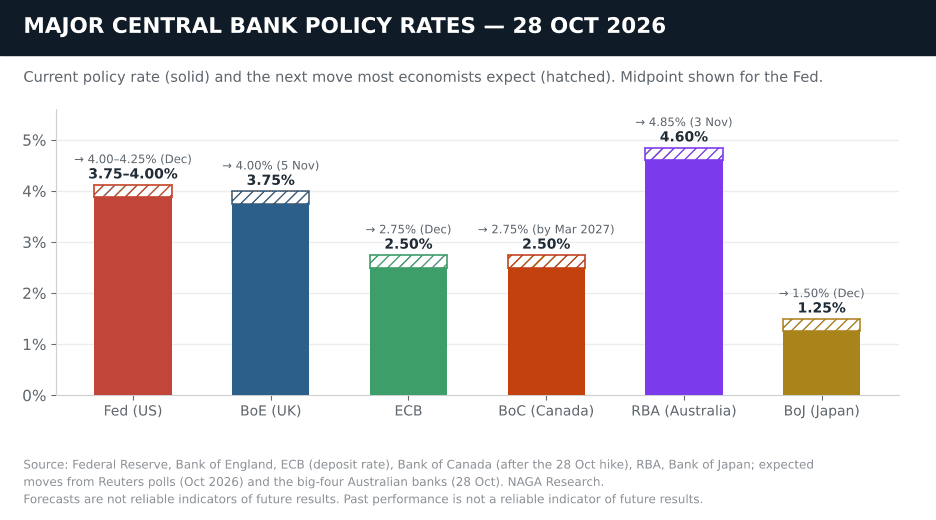
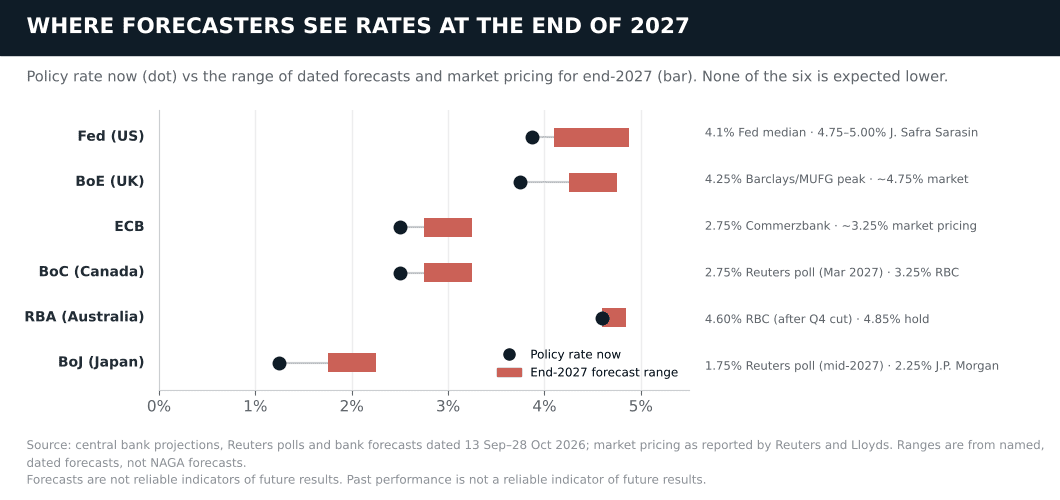
Interest rates are going up, not down, at most major central banks. The Fed (3.75–4.00%), the ECB (deposit rate 2.50%), the RBA (4.60%), the Bank of Japan (1.25%) and, on 28 October, the Bank of Canada (2.50%) have all raised rates since June, and the Bank of England (3.75%) is expected to follow on 5 November. None of the forecasts reviewed here sees a cut by any of the six before mid-2027, and the Fed's own projections show no cut until 2028. The Fed held on 28 October, with two officials voting for a hike and markets pricing a December hike at around 80%; the ECB decides on 29 October, followed by the Bank of Japan (30 October), the RBA (3 November) and the Bank of England (5 November).
Frank Walbaum, Market Analyst at NAGA and a former hedge fund manager, in his Q4 2026 Market Outlook, sees the Fed as the central driver for markets this quarter: "While no immediate rate hike is necessarily expected in the near term, the Fed's reaction to incoming inflation and employment data will remain critical for currencies, commodities and equities."
The global interest rate picture is very different from where it stood 18 months ago. Between mid-2024 and late 2025 the Fed, the Bank of England, the ECB and the Bank of Canada cut rates and the RBA cut three times in 2025, while the Bank of Japan was already raising rates. Then the US–Israeli war on Iran, which began on 28 February 2026, shut the Strait of Hormuz to most shipping and sent Brent crude briefly above $126 a barrel at the end of April, reigniting energy-driven inflation in almost every major economy.
The result is a synchronised tightening cycle heading into the end of 2026. The ECB, the RBA and the Bank of Japan have each raised rates at least twice this year, the Fed hiked in September, the Bank of Canada hiked on 28 October, and the Bank of England has moved from debating cuts to preparing a hike.
The key question for the next year is not "will interest rates go down?" but how high they go and how long they stay there. The answer depends mostly on oil: Brent settled at $113.88 a barrel on 27 October, far above the roughly $70 it traded at before the war, even as Saudi, Turkish and Pakistani officials met Iran's leaders in Tehran on 26 October to discuss the strait.
Interest Rates Forecast 2026–2027 — Key Notes
- US Interest Rate forecast: US interest rates are not expected to go down before mid-2027 at the earliest. The Fed raised its target range to 3.75–4.00% on 16 September and held it there on 28 October, with two officials voting for another hike; all 100 economists in the latest Reuters poll expect a hike in December. The Fed's own September projections put the rate at about 4.1% at the end of both 2026 and 2027, with the first cut only in 2028.
- UK Interest Rate Forecast: UK interest rates are more likely to go up than down. Bank Rate has been 3.75% since December 2025, but 54 of 63 economists polled by Reuters expect a hike to 4.00% on 5 November, and markets price about four hikes by the end of 2027. UBS, one of the few banks to forecast cuts, does not expect them before the fourth quarter of 2027.
- ECB Rates Forecast: ECB rates are not expected to go down before late 2027. The deposit rate is 2.50% after hikes in June and September; a hold is expected on 29 October, and 64 of 73 economists polled by Reuters expect a hike to 2.75% in December.
- Canada Interest Rate Forecast: Canada has moved from the cut camp to the hike camp. The Bank of Canada raised its policy rate by 25 basis points to 2.50% on 28 October, its first hike since July 2023, and said further increases could be needed. 16 of 29 economists in the latest Reuters poll expect another hike to 2.75% by the end of March 2027.
- Australia Interest Rate Forecast: Australian interest rates are rising. The RBA has hiked four times in 2026, to 4.60% in September, and all four major banks now expect a fifth hike to 4.85% on 3 November after September inflation jumped to 4.3%. None of them forecasts a cut.
- Japan Interest Rate Forecast: Japan's interest rates are still moving up. The Bank of Japan raised its policy rate to 1.25%, a 31-year high, on 18 September; a hold is expected on 30 October, and most economists expect a hike to 1.50% in December.
Six central banks moving in the same direction is a big shift for currencies, bond yields and equity indices. With NAGA, you can trade CFDs on forex pairs, indices and other rate-sensitive markets, or follow and copy lead traders who specialise in macro and rate-driven strategies.
Global Interest Rate Policy — What Is Driving Every Central Bank in 2026
Before looking at each central bank, it is worth understanding the single event behind almost every policy decision in 2026: the war between the US, Israel and Iran, which began with US–Israeli strikes on 28 February 2026. Iran closed the Strait of Hormuz, which normally carries about a quarter of the world's seaborne oil trade, and Brent crude rose from about $70 a barrel before the war to a wartime high above $126 on 30 April. A ceasefire agreed in June collapsed on 8 July, and Brent still settled at $113.88 on 27 October. The result has been a second wave of inflation: US consumer prices rose 3.7% in the year to September, euro area inflation reached 3.8% and Australian inflation 4.3%, all well above central bank targets.
The difficulty for central banks is that this inflation is mainly supply-driven. Rate hikes cannot increase oil supply or reopen the Strait. But central banks' credibility rests on showing that an energy shock will not spill into wages and underlying prices, and that imperative — protecting inflation expectations rather than fixing the supply problem — is why they have been raising rates even as growth slows. ECB President Christine Lagarde put it this way in September: "while the shock is too large to look through, we view a measured response as appropriate to keep inflation in check."
The easing cycle has reversed. Since June, the ECB has hiked twice (to 2.50%), the Bank of Japan twice (to 1.25%), the RBA once more (to 4.60%, its fourth hike of 2026) and the Fed once (to 3.75–4.00% on 16 September). The Bank of Canada joined them on 28 October with its first hike since 2023, and markets expect the Bank of England to follow on 5 November. This is not a pause; it is a policy shift driven by the energy shock.
US Interest Rate Forecast 2026
The Federal Reserve raised its target range by 25 basis points to 3.75–4.00% on 16 September in a unanimous vote, three months after Kevin Warsh's first FOMC meeting as chair ended with rates on hold. It was the Fed's first hike since 2023, after three cuts in late 2025. Warsh was blunt at his press conference: "The plain fact is that inflation is too high and has been for too long."
The September projections moved further in a hawkish direction. The median official now expects the federal funds rate at about 4.1% at the end of both 2026 and 2027 (up from 3.8% and 3.6% in June) and 3.9% at the end of 2028, which implies one more hike this year and no cut until 2028. Seventeen of 18 participants still see upside risks to inflation, and the Fed expects PCE inflation of 3.7% this year. US consumer prices rose 3.7% in the year to September, while payrolls grew by only 29,000 and unemployment rose to 4.2%.
At his press conference after the 28 October hold, Chair Kevin Warsh declined to commit to a December move but kept it on the table: "We've made clear our readiness to act as circumstances require, and we have shown our willingness to act." He also said that "While overall financial conditions are tighter, I'm unwilling and unable to call them tight", and repeated that he does not give forward guidance outside a crisis. September PCE inflation (29 October) and the October jobs and inflation reports are the next data points before the 9 December decision.
When Will US Interest Rates Go Down?
US interest rates are unlikely to go down before mid-2027 at the earliest. The Fed held its target range at 3.75–4.00% on 28 October, but two officials, Governor Lisa Cook and Cleveland Fed President Beth Hammack, voted for an immediate hike. After the decision, futures priced a December hike at around 80% (81.4% on CME FedWatch), and all 100 economists in the latest Reuters poll expect a hike to 4.00–4.25% at the next meeting on 9 December. Among the forecasts reviewed here, only Citi's sees cuts in 2027, starting in June, while Morgan Stanley and UBS add a further hike in March 2027. Frank Walbaum notes that "weaker employment data can put policymakers in a difficult position", a reminder that the path could change quickly if the labour market cracks.
Next FOMC Decision: December 9, 2026 US Dollar Index Live Chart →
US Interest Rate Forecast — Next 5 Years
The Fed's longer-run "neutral" rate, at which policy neither stimulates nor restrains the economy, is now 3.2% in the median projection, up from 3.1% in June, which confirms that the era of near-zero rates is over. Officials expect the policy rate to stay near 4.1% through 2027 and then drift lower, to 3.9% at the end of 2028 and 3.6% in 2029, as inflation returns to 2%.
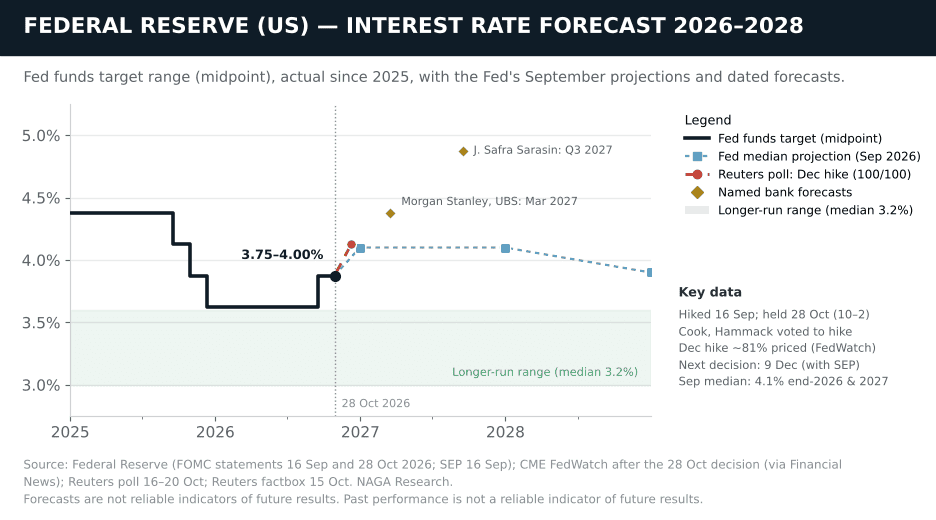
The pace of that descent depends mainly on oil and the labour market. A durable reopening of the Strait of Hormuz would bring headline inflation down quickly and could pull the first cut forward; a prolonged conflict, or inflation spreading into services and wages, would mean more hikes first. At the hawkish end, J. Safra Sarasin expects the Fed to reach 4.75–5.00% by the third quarter of 2027.
UK Interest Rate Forecast 2026
The Bank of England has kept Bank Rate at 3.75% since December 2025, but the Monetary Policy Committee has moved steadily towards tightening. At the July and September meetings, three of the nine members (Megan Greene, Catherine Mann and Chief Economist Huw Pill) voted for a hike to 4.00%. UK CPI inflation rose to 3.5% in September, with services inflation at 3.7%, and the Bank expects inflation to peak slightly above 4% in early 2027.
The next decision, on 5 November, comes with a new Monetary Policy Report. After the September inflation data, markets priced a hike to 4.00% at about 96% and roughly even odds of a second hike by December, according to market data reported on 21 October, and 54 of 63 economists polled by Reuters expect the November move. Chancellor John Healey's Budget, due on 28 October, adds a fiscal variable.
When Will UK Interest Rates Go Down?
UK interest rates are not expected to fall in 2026, and probably not in 2027 either. Barclays, J.P. Morgan, ING and MUFG expect hikes in November and February, taking Bank Rate to 4.25%, while markets price about four hikes by the end of 2027. UBS forecasts the first cut only in the fourth quarter of 2027. Governor Andrew Bailey warned in September: "It's going to get harder to maintain that stance the longer we have high energy prices."
UK Interest Rate Forecast — Next 5 Years
The Bank of England cut Bank Rate by a total of 150 basis points in six steps between August 2024 and December 2025, from 5.25% to 3.75%. Part of that easing is now being reversed: markets price Bank Rate at around 4.75% within a year. Beyond 2027, the path depends on how quickly inflation falls once the energy shock fades; the Bank publishes no official neutral rate, but MPC members have pointed to around 3%.
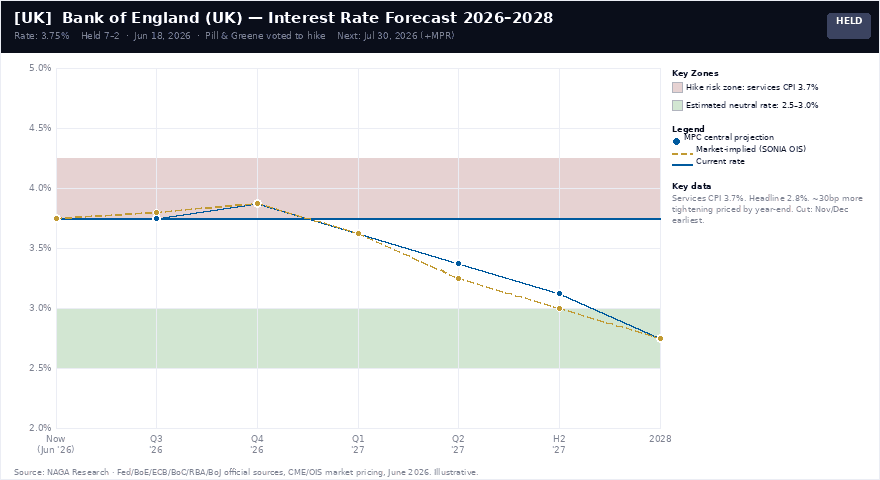
The key UK variables are services inflation (the MPC's main concern), pay growth and fiscal policy. Regular pay growth has slowed to 3.7% and private-sector pay to 3.0%, which argues against a long hiking cycle, while Prime Minister Andy Burnham's government, in office since July, faces its first Budget test in the gilt market. Unemployment is 4.7%.
Pound forecast and price predictions
ECB Interest Rate Forecast 2026
The ECB raised its deposit facility rate by 25 basis points to 2.50% on 10 September, in a unanimous decision that President Christine Lagarde called "a no-brainer". It was the second hike of 2026, after the June move to 2.25%, the first since 2023. The ECB had cut rates eight times between June 2024 and June 2025 and then held at 2.00% until June 2026.
The September staff projections see euro area inflation at 3.0% in 2026, 2.5% in 2027 and 2.1% in 2028, peaking at 3.6% in the fourth quarter, with growth of only 0.9% this year. Inflation has already reached 3.8% in September, driven by energy prices up 18.9% on the year. The ECB's next decisions are on 29 October and 17 December, when new projections are due.
When Will ECB Rates Go Down?
ECB rates are not expected to go down in 2026, and the next move is more likely up. A hold is almost fully priced for 29 October, but 64 of 73 economists polled by Reuters expect a hike to 2.75% in December, and markets price close to three hikes by the end of 2027. Goldman Sachs expects the ECB to start normalising rates only from late 2027, and Commerzbank sees the deposit rate unchanged at 2.75% through 2027. For borrowers, three-month EURIBOR has risen from 2.03% at the start of the year to 2.64% on 26 October.
ECB Forecast — Next 5 Years and EURIBOR Implications
Chief Economist Philip Lane puts the euro area's neutral rate at roughly 1.75–2.50%, so at 2.50% the deposit rate already sits at the top of that range and further hikes would mean tightening into a slow economy. That is a delicate position given high public debt in some member states: Italy's debt ratio was about 137% of GDP at the end of 2025, and France's 10-year bond yield rose above 5% in October.
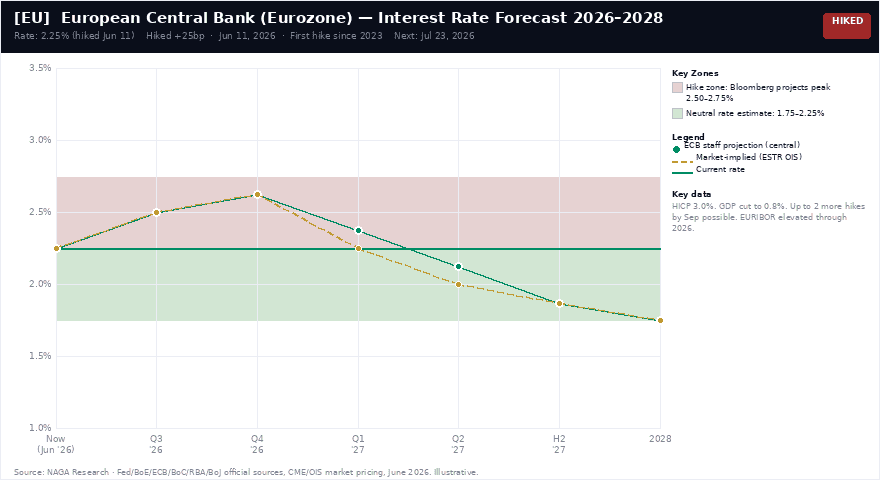
A lasting resolution of the conflict would let energy prices fall and could bring the ECB back towards neutral from late 2027. Until then, EURIBOR, the benchmark for many European mortgages and corporate loans, is likely to stay elevated or rise further, because markets already price additional hikes into next year.
Euro to US Dollar forecast and price predictions 2026
Bank of Canada Interest Rate Forecast 2026
The Bank of Canada raised its policy rate by 25 basis points to 2.50% on 28 October, its first hike since July 2023, after seven straight holds at 2.25%. It had cut from 5.00% between June 2024 and October 2025. Governor Tiff Macklem said the move was needed to stop elevated energy prices from spreading into broader inflation, and added: "There could be a need to increase the policy rate further, but given uncertainties, we will proceed carefully."
The new Monetary Policy Report raises the inflation outlook sharply. CPI inflation, 3.1% in September, is expected to reach about 3.5% by the end of 2026, average about 3% in 2027 (a percentage point higher than in July) and return to about 2% by mid-2028. Growth is forecast at about 1% this year and 2% in 2027 and 2028, although the Bank expects it to slow to 0.8% annualised in the fourth quarter as new US tariffs bite.
When Will Canadian Interest Rates Go Down?
Canadian interest rates are not expected to go down in 2026 or 2027. After the 28 October hike, the Bank said it will take decisions one meeting at a time; 16 of 29 economists in the latest Reuters poll expect a second hike to 2.75% by the end of March 2027, and RBC's 13 October forecast had the rate at 3.25% by the end of 2027. The next decision is on 9 December.
Canadian Interest Rates — Next 5 Years
The Bank of Canada cut from 5.00% to 2.25% between June 2024 and October 2025, one of the largest easing cycles among the major central banks. At 2.50%, the policy rate is still in the lower half of the Bank's estimated neutral range of 2.25–3.25%, which leaves room for further hikes without making policy restrictive.
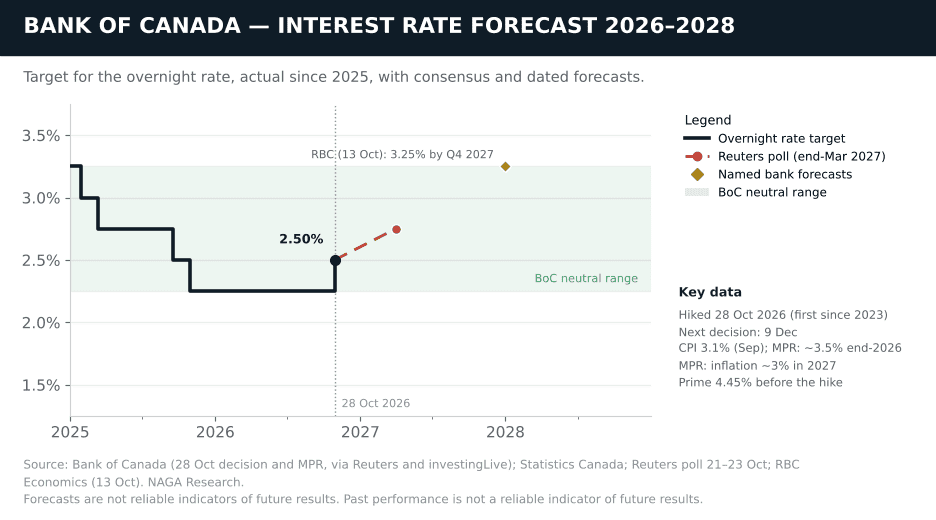
RBC's 13 October forecast had the rate rising step by step to 3.25% by the end of 2027, the top of the neutral range. Canadian banks' prime rates, 4.45% before the hike, normally move with the policy rate, so variable-rate mortgage holders will feel the increase directly.
Oil forecast and price predictions 2026
RBA Interest Rate Forecast 2026 (Australia)
The Reserve Bank of Australia raised the cash rate by 25 basis points to 4.60% on 29 September, its fourth hike of 2026, in a unanimous decision. The Board said the conflict in the Middle East had "broadened" and that energy prices were well above its August forecasts. The RBA had cut three times in 2025, to 3.60%, before reversing course in February.
Inflation has kept rising. Headline CPI reached 4.3% in the year to September and the monthly trimmed mean 3.6%, well above the 2–3% target, and the quarterly trimmed mean rose 1.0% against the RBA's forecast of 0.8%. Governor Michele Bullock said in September: "The Board will increase interest rates again if that's what's needed to get inflation down."
When Will Australian Interest Rates Go Down?
Australian interest rates are not expected to go down in 2026, and the next move is likely to be up. After the September inflation data, all four major banks (CBA, Westpac, NAB and ANZ) expect a fifth hike to 4.85% on 3 November, which markets price at about 87–90%, according to CBA and The Adviser. CBA and NAB then expect a pause, while Westpac sees a risk of another hike in February 2027. None of the four forecasts a cut.
Australian Interest Rates — Next 5 Years
Australia's rate cycle has been longer than most. The RBA hiked from 0.10% in May 2022 to 4.35% in November 2023, cut to 3.60% in 2025 and has added another 100 basis points in 2026. The RBA publishes no single neutral rate; NAB's analysis implies around 3.4%, roughly 1.5 percentage points below the 4.85% now expected.
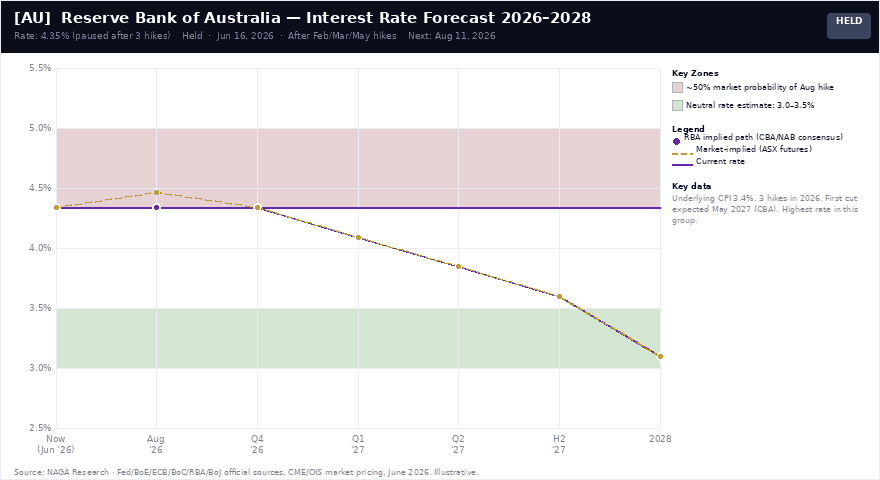
RBC expects the cash rate to stay at 4.85% until the third quarter of 2027 before a first cut to 4.60% in the fourth quarter. A faster path down would need oil prices to fall and the labour market to loosen further; unemployment has already risen to 4.7%, a five-year high.
Gold forecast and price predictions 2026
Bank of Japan Interest Rate Forecast 2026
The Bank of Japan raised its policy rate by 25 basis points to 1.25%, a 31-year high, on 18 September in a 7–2 vote, after an earlier hike to 1.00% in June. The Bank said it would "continue to raise the policy interest rate" as underlying inflation approaches 2%. The yen has been a major factor: Japan has spent more than ¥27 trillion on currency intervention this year, and the dollar still buys about 158 yen.
Price pressure is building in the pipeline. Wholesale prices rose 6.8% in the year to September and yen-based import prices 24.5%, while core consumer inflation is 2.1%, held down by energy subsidies. Deputy Governor Ryozo Himino said on 21 October: "Even after last month's rate hike, financial conditions remain accommodative."
When Will Japanese Interest Rates Go Down?
Japanese interest rates are not going down; they are still going up. A hold is expected at the 29–30 October meeting, but 54 of 78 economists polled by Reuters expect a hike to 1.50% by the end of the year, mostly in December, and most expect 1.75% by mid-2027. Board member Naoki Tamura has argued for raising the policy rate "by 0.25 percentage points at intervals of a few months" towards a neutral level of around 2%.
Japan Interest Rates — Next 5 Years
Japan's exit from ultra-loose policy is one of the most important monetary developments of the decade. The BoJ ended negative rates in March 2024 and has raised its policy rate from −0.1% to 1.25% since then, unwinding part of the yen carry trade that kept the currency weak and global funding cheap. The Bank has no official rate target; its own estimates put the neutral rate in a wide range of roughly 1.1–2.5%.
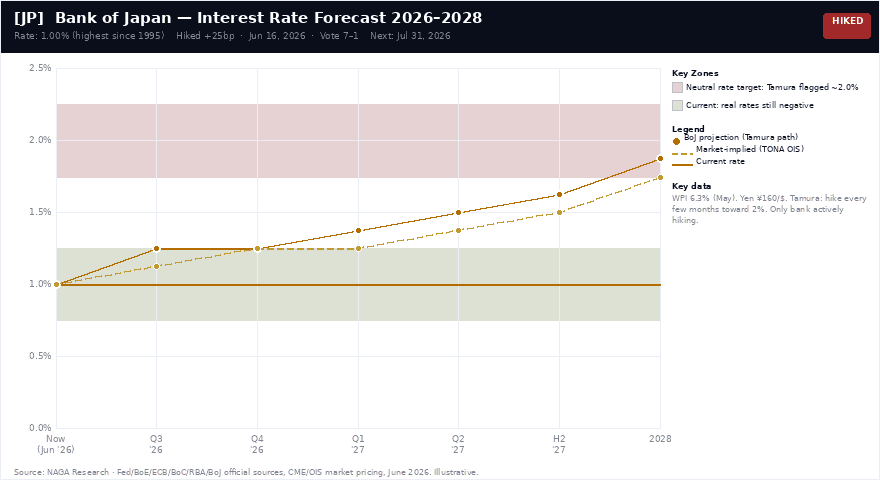
Each BoJ hike narrows the yield gap between the yen and the dollar, euro and pound. From 1.25%, three more 25-basis-point hikes would bring the rate to Tamura's 2% reference point; about half of the economists in the Reuters poll see a terminal rate of 2.00% or higher, and J.P. Morgan expects 2.25% by the end of 2027. That path depends on underlying inflation staying at or above 2% and on continued wage growth.
How to invest in the Japanese stock market
Interest Rates Forecast Summary — All Major Central Banks
Central Bank Current Rate Last Decision Next Meeting Consensus to Year-End 2027 (Named Forecasts) Direction Fed (US) 3.75–4.00% Held 10–2, Oct 28 (2 for a hike) Dec 9 (+ SEP) Hike to 4.00–4.25% in Dec Fed median 4.1%; first cut 2028 (Citi: Jun 2027) ▲ Hiking BoE (UK) 3.75% Held 6–3, Sep 17 Nov 5 (+ MPR) Hike to 4.00% on Nov 5; second hike possible Peak 4.25% (Barclays, MUFG); cuts from Q4 2027 (UBS) ▲ Hike expected ECB (Eurozone) 2.50% Hiked +25bp, Sep 10 Oct 29; Dec 17 Hold on Oct 29; hike to 2.75% in Dec 2.75% (Commerzbank); easing from late 2027 (Goldman) ▲ Hiking BoC (Canada) 2.25% Hiked +25bp, Oct 28 Dec 9 Further hike possible; Bank to "proceed carefully" 2.75% by Mar 2027 (poll); 3.25% end-2027 (RBC) ▲ Hiking RBA (Australia) 4.60% Hiked +25bp, Sep 29 Nov 3 (+ SMP); Dec 8 Hike to 4.85% on Nov 3 4.85%; first cut Q4 2027 (RBC) ▲ Hiking BoJ (Japan) 1.25% Hiked +25bp, Sep 18 Oct 30; Dec 18 Hold on Oct 30; hike to 1.50% in Dec 1.75% by mid-2027; peak 2.00% or higher ▲ Hiking
Interest rate forecasts are based on central bank communications and projections, economists' polls and market pricing as of October 29, 2026, including the Bank of Canada and Fed decisions of 28 October but before the ECB and Bank of Japan decisions of 29–30 October. Forecasts are subject to change and do not constitute investment or financial advice. Past performance is not a reliable indicator of future outcomes.
Central Bank Meeting Calendar 2026–2027
These are the remaining 2026 decision dates (after the Bank of Canada and Fed decisions of 28 October) and the first half of the 2027 calendar for the six central banks. For two-day meetings, the date shown is the decision day.
Federal Reserve: 9 December 2026; 27 January, 17 March, 28 April and 9 June 2027.
Bank of England: 5 November and 17 December 2026; 4 February, 18 March, 29 April and 17 June 2027.
European Central Bank: 29 October and 17 December 2026; 4 February, 18 March, 29 April and 10 June 2027.
Bank of Canada: 9 December 2026; 27 January, 3 March, 28 April and 2 June 2027.
Reserve Bank of Australia: 3 November and 8 December 2026; 9 February, 23 March, 4 May and 22 June 2027.
Bank of Japan: 30 October and 18 December 2026; 22 January, 18 March, 28 April and 11 June 2027.
Each of these decisions can move currencies, bond yields and stock indices. The NAGA economic calendar lists the release times and consensus forecasts.
Will Interest Rates Go Down in 2026?
For the world's major economies, no. The war with Iran has turned what was expected to be a year of rate cuts into a year of hikes, and markets now price further increases into 2027 at most of the six central banks. Here is where each one stands:
Federal Reserve - Not before mid-2027
Consensus (Reuters poll): hike to 4.00–4.25% in December
The Fed's median sees 4.1% at the end of 2027 and no cut until 2028. Citi expects a first cut in June 2027.Bank of England - Hikes first
Consensus (Reuters poll): hike to 4.00% on 5 November
Barclays and MUFG see a 4.25% peak in early 2027. UBS expects the first cut in Q4 2027.ECB - Hiking, cuts from late 2027
Consensus (Reuters poll): hike to 2.75% in December
Rates went up in June and September. Goldman Sachs sees easing only from late 2027.Bank of Canada - Hiking
Hiked to 2.50% on 28 October; more possible
Reuters poll: 2.75% by end-March 2027. No major bank forecasts a cut in 2026–27.RBA (Australia) - Hiking
Big-four banks: hike to 4.85% on 3 November
Four hikes already in 2026 and the highest rate of the group. RBC sees a first cut in Q4 2027.Bank of Japan - Hiking
Consensus (Reuters poll): hike to 1.50% in December
Most economists see 1.75% by mid-2027; about half expect 2% or more later. No cut is forecast.
The biggest caveat is that all of these forecasts depend on the conflict and on energy prices. A durable US–Iran agreement that reopens the Strait of Hormuz and brings Brent back below $90 would change the calculus for the Fed, the ECB and the Bank of England within a few months of inflation data, and could pull the first cuts into 2027. An escalation, which President Trump has suggested could follow the 3 November US midterm elections, would do the opposite and raise the odds of more hikes everywhere at once.
Learn to Trade Interest Rate Moves with NAGA
- Practice trading interest rate-sensitive assets — bonds, forex, indices — with $100,000 in virtual funds. No risk, real markets.
- Learn how interest rate decisions affect forex (GBP/USD, EUR/USD), bond yields, and equity markets in our free educational hub.
Disclaimer: The information provided is for general informational purposes only and does not constitute investment advice, an investment recommendation, a personalised recommendation, or an offer or solicitation to engage in any investment activity.
Sources
- Federal Reserve — FOMC Meeting Calendars
- Federal Reserve — FOMC statement, October 28, 2026
- Federal Reserve — Press conference transcript, October 28, 2026 (PDF)
- Federal Reserve — FOMC statement, September 16, 2026 (PDF)
- Federal Reserve — Summary of Economic Projections, September 16, 2026
- Bank of England — Monetary Policy Summary and Minutes, September 2026
- European Central Bank — Monetary policy decisions, September 10, 2026
- European Central Bank — Staff macroeconomic projections, September 2026
- Bank of Canada — Policy interest rate and announcement schedule
- Bank of Canada — Interest rate announcement, September 2, 2026
- Reserve Bank of Australia — Monetary Policy Decision, September 29, 2026
- Bank of Japan — Statement on Monetary Policy, September 18, 2026 (PDF)
- Office for National Statistics — Consumer price inflation, UK: September 2026
- Eurostat — Euro area annual inflation, September 2026
- Australian Bureau of Statistics — CPI rose 4.3% in the year to September 2026
- Statistics Canada — Consumer Price Index, September 2026