




The global orange juice market is one of the world's most closely watched soft commodity markets, with prices influenced by weather conditions, citrus diseases, harvest yields, and changing consumer demand. Because orange juice production is concentrated in only a handful of countries, supply disruptions can trigger significant price swings, creating opportunities for both active traders and long-term investors.
Following several years of supply shortages caused by citrus greening disease, adverse weather, and lower inventories, the orange juice market entered 2026 with production gradually recovering in some regions. Nevertheless, climate risks, disease outbreaks, and global trade dynamics continue to make orange juice one of the most volatile agricultural commodities traded on international futures markets.
Orange Juice Trading and Investing – Key Takeaways
- From weather conditions in Brazil to citrus greening disease and global supply trends, orange juice markets are driven by agricultural fundamentals that traders and investors can actively monitor.
- Weather conditions, harvest forecasts, disease outbreaks, and export activity regularly influence orange juice prices, creating both short-term trading opportunities and longer-term investment potential.
- Investors can gain exposure through direct instruments like Orange Juice Futures (ICE) and CFDs, or indirectly through agriculture-related ETFs and publicly traded stocks, depending on their investment strategy.
- Live charts, multiple trading instruments, and integrated risk management tools help traders navigate global orange juice markets with NAGA.
Understanding the orange juice market
Orange juice has been traded on commodity exchanges for decades and remains one of the world's most weather-sensitive agricultural commodities. Unlike grains or sugar, orange juice production is concentrated in relatively few producing regions, making prices particularly vulnerable to hurricanes, frosts, droughts, and citrus diseases.
Before investing in orange juice markets, it helps to understand where oranges are grown, which countries dominate global production, and why weather events in just a few regions can have a major impact on global supply and prices.
Top orange-producing countries
Global orange production exceeds 75 million metric tons annually. Brazil remains the world's largest orange producer and the leading exporter of orange juice, while India, China, Mexico, and the United States are also among the largest producers. Brazil alone accounts for roughly 70% of global orange juice exports, giving the country considerable influence over international prices.
The market has experienced repeated supply disruptions due to citrus greening disease, hurricanes in Florida, droughts in Brazil, and changing weather patterns. These factors continue to create periods of tighter supplies and elevated price volatility across global orange juice markets.
Orange juice prices in recent years
Orange juice prices have experienced exceptional volatility in recent years, driven by declining inventories, citrus disease, and adverse weather affecting key producing regions. Futures reached record highs during 2023–2024 before entering a sharp correction as production expectations improved and demand softened.

During the second half of 2026, Orange Juice Futures (ICE) largely traded between 130 and 150, with OrangeJuice CFD (ICE) on NAGA hovering around 135–136. Although production conditions have improved compared with previous seasons, weather risks and disease outbreaks continue to drive periodic volatility, keeping traders focused on global crop developments.
These price movements continue to attract commodity traders seeking short-term opportunities, while beverage manufacturers, food processors, and institutional participants use orange juice futures markets to hedge against fluctuations in raw material costs.
What drives orange juice prices?
Orange juice prices are influenced by a combination of agricultural, environmental, and economic factors. Because production is concentrated in only a few major exporting countries, supply disruptions can have a significant impact on global prices. Traders closely monitor weather conditions, crop reports, and global demand to anticipate potential price movements.
The six main factors influencing orange juice prices include:
Weather conditions and hurricanes
Orange production is highly sensitive to adverse weather. Hurricanes, frosts, droughts, and excessive rainfall can reduce crop yields and damage orchards, particularly in major producing regions such as Brazil and Florida, often leading to higher orange juice prices.
Citrus greening disease (HLB)
Citrus greening, also known as Huanglongbing (HLB), remains one of the most significant long-term threats to orange production. The disease reduces fruit quality, lowers yields, and has contributed to declining production in several key growing regions over the past decade.
Global supply and demand
Changes in harvest volumes, inventory levels, and consumer demand directly influence market prices. Strong demand combined with lower production often supports higher prices, while abundant harvests and rising inventories can put downward pressure on the market.
Export activity and trade policies
Since Brazil dominates global orange juice exports, changes in export volumes, tariffs, transportation costs, and international trade policies can significantly affect global supply availability and price expectations.
Currency movements
Orange juice is internationally traded in US dollars, meaning exchange rate fluctuations can affect both producer profitability and export competitiveness. A weaker Brazilian real, for example, may encourage exports, while a stronger currency can reduce export incentives.
Consumer demand and beverage trends
Changing consumer preferences, health trends, and demand from the food and beverage industry influence long-term orange juice consumption. Shifts toward healthier beverages or changing breakfast habits can affect demand and, ultimately, market prices.
Orange juice price forecast 2026–2030
The orange juice market outlook for 2026 and beyond points to a gradual stabilization following several years of extreme price volatility driven by citrus greening disease, adverse weather, and lower global inventories. While production is expected to improve in some key growing regions, analysts believe orange juice prices will remain above long-term historical averages as climate risks and crop diseases continue affecting global supply.
- USDA orange market projections: The USDA expects global orange production to recover modestly during the 2026/27 season as improved growing conditions support larger harvests in several producing countries. However, citrus greening disease and weather-related risks are expected to continue limiting production potential in major exporting regions.
- World Bank commodities outlook: The World Bank expects agricultural commodity prices to remain relatively stable through 2026, although soft commodities such as orange juice may continue experiencing above-average volatility due to climate risks, production uncertainty, and changing global demand.
- USDA Citrus Outlook: The USDA's citrus outlook indicates that Florida's orange production remains well below historical averages despite signs of gradual recovery. Brazil is expected to remain the dominant global orange juice exporter, with production trends continuing to play a major role in international pricing.
- Rabobank commodities research: Rabobank expects orange juice futures to remain highly sensitive to weather developments in Brazil and disease pressure across major citrus-growing regions. The bank notes that prices are likely to fluctuate broadly within the 120–170 range during 2026, depending on harvest conditions, inventories, and export availability.
Orange Juice Price Forecast 2026–2030: Analyst and Institutional Outlooks
Institution Key Forecast USDA Modest production recovery during 2026/27 World Bank Stable agricultural commodity prices through 2026 USDA Citrus Outlook Florida output gradually recovering; Brazil remains dominant exporter Rabobank Expected trading range: 120–170 during 2026
Climate-related risks remain one of the biggest long-term challenges for orange juice markets. Hurricanes, prolonged droughts, extreme temperatures, and the continued spread of citrus greening disease (HLB) may continue affecting orchard productivity across major producing regions, contributing to elevated price volatility throughout the remainder of the decade.
At the same time, global demand for fruit-based beverages and premium juice products is expected to support long-term orange juice consumption. As production gradually recovers while supply risks persist, orange juice is likely to remain one of the most closely watched and weather-sensitive soft commodities traded on international futures markets.
How to trade and invest in the orange juice market
There are several ways traders and investors can gain exposure to orange juice markets depending on their risk tolerance, investment horizon, and financial objectives. Some prefer direct exposure through futures and CFDs, while others choose indirect exposure through ETFs or shares of companies operating across the global citrus and beverage supply chain.
Your choice will also depend on whether you are looking to trade short-term price movements or build longer-term exposure to the global orange juice market.
Trading orange juice futures
When traders invest in orange juice markets, they typically gain exposure through trading futures, the most liquid and actively traded orange juice instruments globally. The primary benchmark is Orange Juice Futures, traded on the Intercontinental Exchange (ICE) and widely used by commodity traders, hedge funds, beverage manufacturers, juice processors, and commercial hedgers to manage orange juice price risk.
Orange juice futures are standardized contracts that allow market participants to buy or sell frozen concentrated orange juice (FCOJ) at a predetermined price on a future date. Traders can go long if they expect prices to rise or short if they anticipate declines, while leverage can amplify both potential gains and potential losses.
Orange Juice Futures traded on ICE offer deep liquidity and electronic trading sessions, providing market participants around the world with access to one of the most weather-sensitive soft commodity markets.
Key orange juice futures mechanics
- Margin trading: Traders deposit only a fraction of the contract value as collateral, allowing leveraged exposure to orange juice price movements.
- Daily settlement: Futures positions are marked to market each trading day, with profits and losses credited or deducted automatically.
- Resolution: Most orange juice futures contracts are closed before expiration, while only a small percentage result in the physical delivery of frozen concentrated orange juice
Key orange juice futures trading specifications
- Primary exchange: Intercontinental Exchange (ICE)
- Underlying asset: Frozen Concentrated Orange Juice (FCOJ-A)
- Contract size: 15,000 pounds of orange juice solids.
- Price quotation: Quoted in US cents per pound.
- Delivery months: Active contracts mature in January, March, May, July, September, and November.
With NAGA, you can trade CFDs on Orange Juice Futures. With CFD trading, you can speculate on changing orange juice prices without owning or taking delivery of the underlying futures contract. CFD trading uses leverage, meaning you only need to deposit a small margin to gain exposure to the full value of the trade. This can magnify both potential profits and potential losses.
Learn more about CFD trading and how does it work
Traditional orange juice funds
Because orange juice is a niche agricultural commodity, there are very few investment products dedicated exclusively to orange juice. Instead, investors typically gain exposure through Exchange-Traded Products (ETPs), including ETFs, ETNs, and diversified agricultural commodity funds that include soft commodities within broader portfolios.
Exchange-Traded Notes (ETNs)
Some exchange-traded notes provide indirect exposure to agricultural commodity indexes that include soft commodities such as orange juice.
- How they work: ETNs track the performance of commodity indexes rather than holding physical assets, allowing investors to participate in agricultural market movements without trading futures directly.
Broad Commodity and Agriculture ETFs
Many investors prefer diversified agricultural funds that include exposure to commodities such as orange juice, sugar, coffee, cotton, corn, and soybeans alongside other agricultural assets.
- How they work: These funds spread investments across multiple agricultural commodities, helping reduce reliance on the performance of a single commodity while improving portfolio diversification.
- Key Examples: Invesco DB Agriculture Fund (DBA) and First Trust Indxx Global Agriculture ETF (FTAG) provide diversified exposure to global agricultural markets.
Actively Managed Commodity Funds
Actively managed commodity funds allocate capital across agriculture, energy, and metals depending on changing macroeconomic conditions and commodity cycles.
- How they work: Portfolio managers actively rebalance holdings to capture market opportunities while managing overall portfolio risk.
- Key Example: First Trust Global Tactical Commodity Strategy Fund (Ticker: FTGC) invests across a diversified portfolio of commodity futures, including agricultural markets.
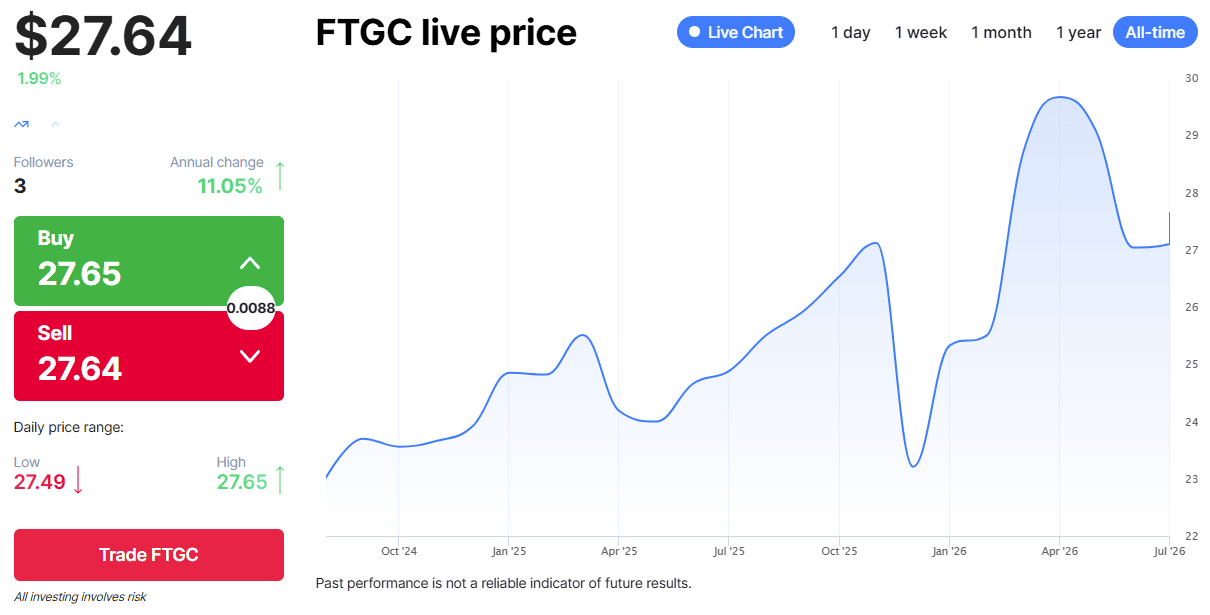
Exchange-traded funds (ETFs) continue to gain popularity among investors seeking diversified commodity exposure. Through NAGA, traders can access a wide range of ETFs and commodity-related instruments under one platform.
Discover the best ETFs for 2026
Orange juice stocks
Orange juice stocks are shares of publicly traded companies whose revenues and profitability are directly or indirectly linked to orange production, citrus processing, beverage manufacturing, or agricultural operations. Because investors cannot buy stock in orange groves directly through public stock markets, many choose companies operating across different stages of the global orange juice supply chain.
- The Citrus Producers & Growers (Upstream): These companies cultivate citrus crops and manage agricultural operations that supply oranges for juice production. Their performance can be influenced by harvest yields, weather conditions, and citrus diseases (e.g., Alico, Inc. (NASDAQ: ALCO)).
- The Beverage Manufacturers (Downstream): Global beverage companies market and distribute orange juice through well-known consumer brands, making part of their business sensitive to orange prices, consumer demand, and raw material costs (e.g., The Coca-Cola Company, PepsiCo, and Keurig Dr Pepper).
- The Agricultural Input Companies (Supporting the Supply Chain): These businesses supply fertilizers, crop protection products, seeds, irrigation systems, and agricultural technologies that support citrus production worldwide (e.g., Corteva, Nutrien, and CF Industries).
Stock prices may be influenced not only by orange juice prices, but also by company earnings, weather conditions, citrus diseases, production costs, consumer demand, currency movements, and broader market trends.

Past performance is not a reliable indicator of future results. All historical data, including but not limited to returns, volatility, and other performance metrics, should not be construed as a guarantee of future performance.
With NAGA you can invest in stocks with ownership or trade stocks via CFDs for more flexibility.
Pros and cons of investing in the orange juice market
Investing in orange juice and orange juice-related assets provides exposure to one of the world's most volatile soft commodity markets. However, returns can be significantly influenced by weather conditions, citrus diseases, global supply dynamics, and changing consumer demand.
Pros of Investing in Orange Juice
Cons of Investing in Orange Juice
High trading opportunities: Orange juice is one of the most volatile agricultural commodities, creating frequent trading opportunities. Weather sensitivity: Hurricanes, frosts, droughts, and excessive rainfall can significantly reduce orange harvests and increase price volatility. Portfolio diversification: Orange juice often behaves differently from stocks, bonds, and many other commodities, helping diversify investment portfolios. Citrus diseases: Diseases such as citrus greening (HLB) can reduce yields for years and disrupt global supply. Strong global demand: Orange juice remains an important beverage worldwide, supporting long-term consumption despite changing consumer preferences. Supply concentration: Global exports rely heavily on a small number of producing regions, making prices vulnerable to local disruptions. Multiple investment options: Investors can gain exposure through futures, CFDs, agriculture ETFs, and related stocks. Leverage risk: Trading orange juice futures or CFDs with leverage can amplify both profits and losses. Liquid futures market: ICE Orange Juice Futures provide transparent pricing and efficient access to global commodity markets. High price volatility: Production shortages, disease outbreaks, and changing weather conditions can trigger sharp price swings over short periods.
Are you looking to build a long-term position in the orange juice market, or are you seeking short-term trading opportunities? Open a demo account and explore different strategies to gain exposure to global orange juice markets.
Orange juice futures trading strategies and examples
Once you've familiarized yourself with the different ways to trade orange juice, you can choose the approach that best fits your trading style and risk tolerance. Some of the most commonly used orange juice trading strategies include:
- Trend following (weather-driven strategy): Traders follow longer-term price movements driven by weather conditions, harvest forecasts, citrus disease outbreaks, and changes in global orange juice inventories.
- Breakout trading (supply shock strategy): Traders look for significant price movements following hurricanes, frost events, USDA crop reports, or production updates from major exporting countries such as Brazil and the United States.
- Range-bound trading (consolidation strategy): Traders take advantage of periods when orange juice prices fluctuate within well-defined support and resistance levels during relatively stable market conditions.
Register to NAGA webinars to learn more about different trading strategies and explore the following real-world orange juice trading examples.
Example A: Trader capturing a short-term orange juice price decline (short trade)
In this scenario, a retail trader using the NAGA trading platform notices improving weather conditions in Brazil and stronger harvest expectations, signaling a potential increase in global orange juice supply. The current price of OrangeJuice.f sits near 146.00.

Past performance is not a reliable indicator of future results. All historical data, including but not limited to returns, volatility, and other performance metrics, should not be construed as a guarantee of future performance.
- The action: The trader opens a short position for 84 units, anticipating that orange juice prices will continue declining as supply pressures ease.
- Investment: Approximately €992.
- The outcome: Two weeks later, orange juice prices fall from 146.00 to 136.00 as improving harvest conditions and stronger production forecasts increase market confidence.
- Gross profit calculation: The market declines by 10.00 points (146.00 − 136.00). Based on the same 84-unit position, this would generate an estimated profit of around €680 before spreads and trading fees.
If the market moves against the short position and orange juice prices rise toward 156.00, the financial outcome reverses.
- Loss calculation: The market increases by 10.00 points (156.00 − 146.00). For the same 84-unit position, this would result in an estimated loss of around €680 before spreads and trading fees.
- Margin account impact: NAGA continuously monitors leveraged positions in real time. If account equity falls below maintenance margin requirements, the platform may trigger a Margin Call or automatic Stop-Out to help protect against negative balances.
Example B: Beverage manufacturer hedging against rising orange juice costs (long hedge)
A global beverage manufacturer expects to purchase large quantities of frozen concentrated orange juice over the next six months. The current orange juice futures price is near 136.00, but management fears adverse weather conditions in Brazil and potential supply disruptions could reduce orange harvests and push prices higher.

Past performance is not a reliable indicator of future results. All historical data, including but not limited to returns, volatility, and other performance metrics, should not be construed as a guarantee of future performance.
- The action: The company executes a long hedge using orange juice futures contracts to secure pricing exposure before its next purchasing cycle.
- The outcome: Six months later, unfavorable weather conditions reduce orange production and push prices toward 146.00, increasing procurement costs across the physical market.
- Physical market impact: The manufacturer faces significantly higher costs when purchasing orange juice concentrate from suppliers due to rising spot market prices.
- Futures market impact: The long futures hedge gains approximately 10.00 points (146.00 − 136.00) in value, helping offset part of the increased purchasing costs.
- Estimated hedge gain: For a comparable 84-unit position, the move could generate an estimated profit of around €680 before spreads and trading fees, partially compensating for the higher procurement costs.
- Net result: The gains from the futures hedge partially offset the increase in physical orange juice purchasing expenses, helping stabilize production costs despite rising market prices.
How to start trading orange juice on NAGA
Getting started with orange juice trading on NAGA is straightforward. The platform provides access to Orange Juice CFDs, live market pricing, and advanced trading tools to help investors and traders navigate one of the world's most volatile soft commodity markets.
- Learn the orange juice market drivers – Weather conditions, hurricanes, citrus greening disease (HLB), harvest forecasts, and global supply trends regularly influence orange juice price movements.
- Choose your trading instrument – Trade Orange Juice Futures (ICE) | OrangeJuice.f for direct market exposure, or gain indirect exposure through agriculture-related stocks, ETFs, and diversified commodity products.
- Use NAGA's analysis tools – Live charts, technical indicators, economic calendars, and market insights help traders identify potential entry and exit opportunities across changing market conditions.
- Apply smart risk management – Use stop-loss and take-profit orders while managing position sizes carefully, particularly during periods of elevated orange juice market volatility, where prices can react sharply to weather events, crop reports, and supply disruptions.
With your strategy in place, NAGA enables you to execute trades manually, follow experienced investors through copy trading, or react quickly to changing market conditions using real-time trading tools.
Conclusion
Orange juice investing offers exposure to one of the world's most weather-sensitive agricultural commodity markets, where prices are driven by climate conditions, citrus diseases, harvest yields, and global supply dynamics. These factors create opportunities for both short-term traders and long-term investors through futures, CFDs, ETFs, and agriculture-related stocks.
NAGA simplifies access to global orange juice markets by offering live pricing, multiple trading instruments, and integrated market analysis tools. Understanding the key drivers of orange juice prices and selecting the right investment approach can help investors navigate volatility and identify potential opportunities across changing market conditions.
Start Trading Orange Juice on NAGA Today
Sources:
- U.S. Department of Agriculture (USDA) – Citrus: World Markets and Trade
- Intercontinental Exchange (ICE) – FCOJ-A Futures Contract Specifications
- World Bank – Commodity Markets Outlook
- Food and Agriculture Organization of the United Nations (FAO)
- Rabobank – Food & Agribusiness Research